


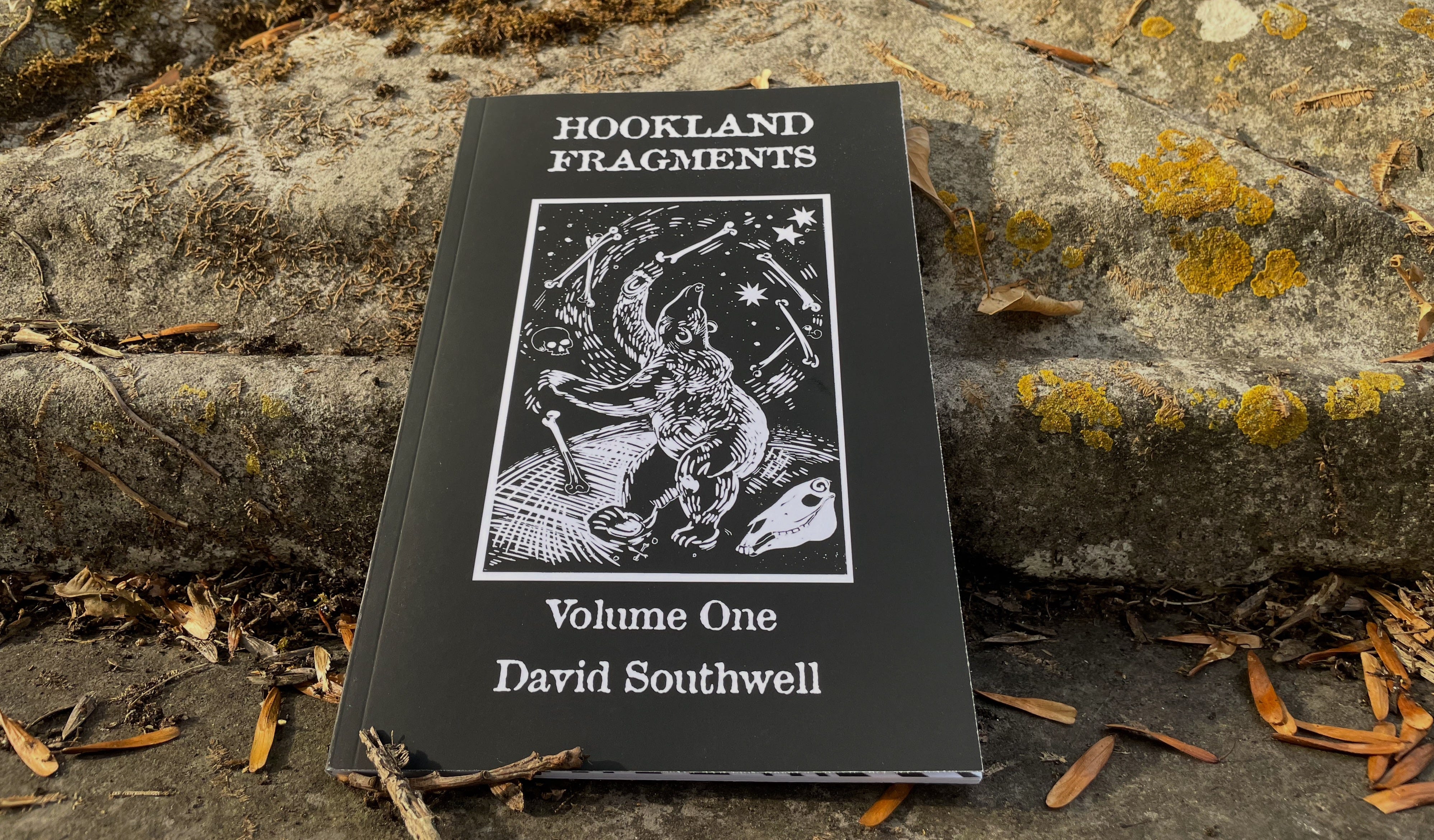
David Southwell is the creator of Hookland, an imagined lost English county brought to life in near-daily postings on social media in the voice of its inhabitants. David’s new book Hookland Fragments: Volume One (Twisted Trunk) documents the country’s folkloric origins, figures from its history, and influences that contributed to its development.
David will be speaking at Treadwell’s Books on 24 September.
What gave you the idea for your book?
For years I’d be trying to persuade my author friends to make better use of the talks they gave. To expand access to the room, to not let months of work dissipate in a single telling. I was snookered when one of them insisted I had to follow my own advice or be a hypocrite. They also pointed out that after 14 years of writing Hookland on social media, maybe the act of expanding access demanded a book both as an introduction and as an exploration of its agenda of re-enchantment as resistance.
How long did it take to write?
It is a small book and yet it took about a month of writing and another month of editing. I’ve slowed down a lot post strokes and other health issues. However, the truth of it is so much of the book is autobiographical it feels like it has taken decades to manifest.
Which writers or artists were inspiring you while you wrote?
Part of the book is an A-Z of influences on the whole project of Hookland. An ABC where it is Aickman, Blackwood and Carter among others. The artist that inspired me most while considering this book was Fay Godwin, especially the way she carved light ‘til the invisible stories stored within the land were shown, her genius at revealing the spectres of absence. The author I felt most on my shoulder in writing the book was J.G. Ballard, not only because I was writing about his invisible literatures, but because in part he is to blame for the whole Hookland project. It was a ride in a BBC cab with J.G. Ballard that led to the creation of Hookland, particularly his advice to: ‘Concentrate on place, nothing without a sense of it is ever any good.’
What do you tell yourself when the going gets tough?
For many of us writing is a territory of doubt. Nothing changes that so you have to find a way to turn off the inner DVD commentary as much as possible. When you are suffering chronic health problems, crumpled like a discarded cola can with pain, that doubt is amplified by an increased sense of low productivity. All I can tell myself is: ‘Don’t whine – write!’
How much do you revise?
Until I become blind to the words.
How did you first get published?
When I realised at 16, no one on a news desk or magazine had to actually know about my lack of experience for me to pitch articles.
What’s the last really good book you read?
Stu Hennigan’s Keshed. It’s one of the best debut novels I’ve ever read. It’s clever, fierce and for those of us who come from working class backgrounds, one of the strongest reminders that you should never pander to anyone. Hennigan’s voice has the gravity dwarf star.
What’s a book more people should read?
Rose Ruane’s Birding. It’s an emotional power-punch that makes you fall in love with novels all over again. Ruane’s use of language is spellbinding and the story is a masterclass on writing emotion, place and the moments of life that are ultimately engines of hope. I don’t think there is a better seaside book. I’m a constant ambassador for it.
Do you have any advice for aspiring authors?
The best bit of advice I was ever given was by Henry Rollins: ‘The only thing that makes you a writer is the act of writing – everything else is adjectives.’ The only other advice I think anyone can give you that’s actually helpful is that it might take up to a thousand pages to flush the crap out of your system and find your own true voice.
Favourite place in London?
London is just layers of stories, both its own and the one’s you make living in it. In terms of my own personal narrative that is entangled in London, my favourite place has to be what was ‘The Wolf Parlour’ at The Coal Hole in The Strand. I’ve fond memories of drinking there with my friend Stephen Grasso, the real DI Callaghan who haunts Hookland, and the actor Richard Harris. It was also where I went on the first date with my wife and summoned a future of love. It’s the perfect ghostscape for me.